

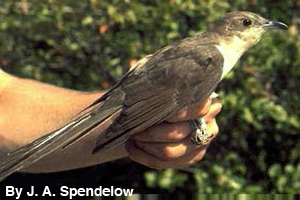
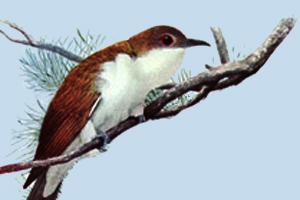
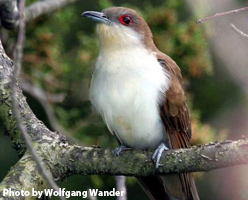
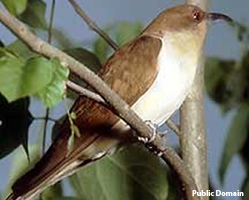

The black-billed cuckoo looks very much like the yellow-billed cuckoo. They look like slim pigeons. Both have brown backs and white breasts.
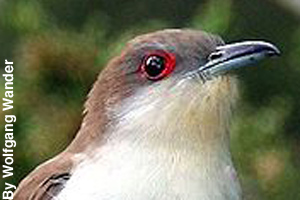
The black-billed cuckoo has no yellow on its bill. It has no rust color on its wings. It does have a ring of red skin around its eyes. Its song sounds like a quick coo coo coo coo.
Both kinds of cuckoos like to sing right before storms. Some people call them rain birds.
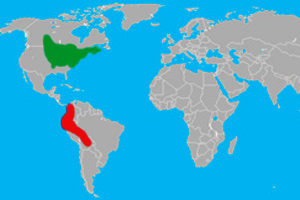
The black-billed cuckoo summers in the United States and a bit of Canada east of the Rockies. It winters in South America.
In the spring, it builds a sloppy nest of twigs and grass. It lays up to four greenish-blue eggs. Sometimes the mother lays eggs in the nests of other birds. The eggs hatch 10 to 13 days later. The baby cuckoo gets its feathers seven to nine days after it hatches.
The cuckoo helps people because it eats a huge amount of spiny caterpillars. Other birds will not eat these types of caterpillars because of the spines.
APA Style: Black-Billed Cuckoo. (2013, June). Retrieved from Facts4Me at https://www.facts4me.com
MLA Style: "Black-Billed Cuckoo." Facts4Me. Jun. 2013. https://www.facts4me.com.