


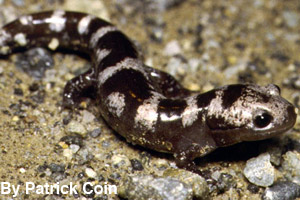
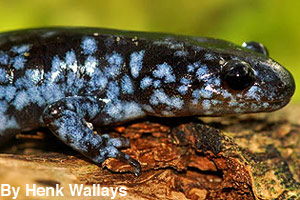
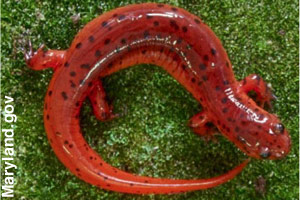

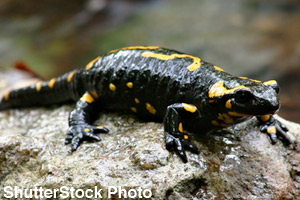

There are many kinds of salamanders. They look different. They have different habits.
A salamander usually looks a bit like a lizard. It has a long tail and four legs. But a salamander’s legs come out from the sides of its body. A lizard’s legs are under its body. A salamander is from three to eight inches (seven to 20 centimeters) long. It often has smooth skin. It needs to keep its skin wet.
Some kinds of salamanders live in water all of the time. Some live in damp places on land. They live under logs and rocks. The female salamander lays her eggs in or near fresh water. The eggs are covered with a poisonous jelly. The jelly helps to keep the eggs safe. The eggs hatch into larvae. A larva may live in fresh water until it is grown. Some kinds of salamanders give birth to live young.
When scared, the salamander may drop its tail and run away from danger. A new tail will grow back. A salamander may also cover its skin with poison. Some kinds of salamanders even throw the poison at their attackers.
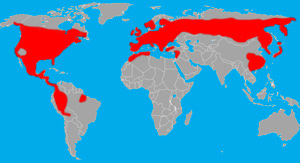
Salamanders can be found in most parts of the world. Some kinds of salamanders are in trouble. People pollute. They drain wetlands and cut down trees. The salamander could run out of places to live.
Salamanders. (n.d.). Illinois Department of Natural Resources. Retrieved from http://dnr.state.il.us/education/salamanders/defense.htm
Heying, H. (n.d.). Animal Diversity: Caudata. Museum of Zoology at the University of Michigan. Retrieved from http://animaldiversity.ummz.umich.edu/accounts/Caudata/
Klappenbach, L. (n.d.). Newts and Salamanders. About Animals and Wildlife. Retrieved from http://animals.about.com/od/newtssalamanders/p/newtssalamanders.htm
Salamander (Caudata). (n.d.). A-Z Animals. Retrieved from http://a-z-animals.com/animals/salamander/
San Diego Zoo's Animal Bytes: Salamander & Newt. (n.d.). The San Diego Zoo. Retrieved from http://www.sandiegozoo.org/animalbytes/t-salamander.html
APA Style: Salamander. (2020, September). Retrieved from Facts4Me at https://www.facts4me.com
MLA Style: "Salamander." Facts4Me. Sep. 2020. https://www.facts4me.com.