

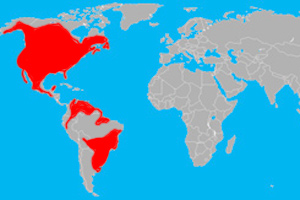
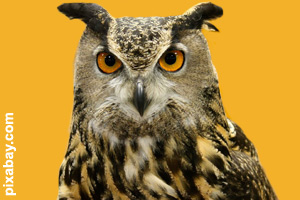

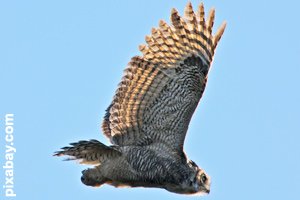
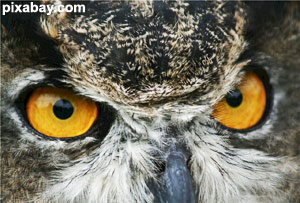

This is the owl that says, whoo whoo. This is also what people usually picture of when they think a wise, old owl. The great horned owl has tufts of feathers that look like ears. It has very big, yellow eyes in front of its face. Some of its feathers look like slanting eyebrows. This owl cannot move its eyes from side to side. It has to turn its whole head instead.
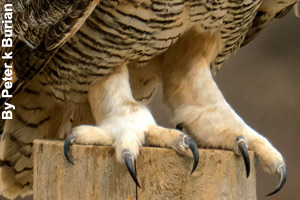
It seems like the owl can turn its head all the way around. It cannot, but it can turn more than half way. The owl uses its good hearing and eyesight to catch prey at night. It has four toes on each foot, two facing the front and two facing the back. These toes close on prey with a vice-like grip.
The great horned owl is nocturnal which means it is active at night. This owl hunts mostly at dusk and at night. After the owl catches its food, it eats it, bones, fur, and all. Later, it will throw up pellets full of bones and hair.
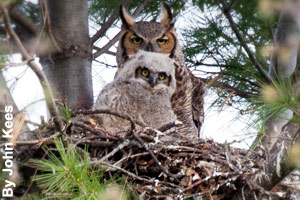
The great horned owl often uses an old crow, hawk, or squirrel nest. The mother lays one to three eggs. The eggs hatch in about a month. The babies are fuzzy at first. They start getting real feathers at about three weeks. They can fly at 10 weeks.
Great Horned Owl. (n.d.). Retrieved from https://www.audubon.org/field-guide/bird/great-horned-owl
Great Horned Owl. (n.d.). Retrieved from http://naturemappingfoundation.org/natmap/facts/great_ horned_owl_k6.html
Great Horned Owl Identification, All About Birds, Cornell Lab of Ornithology. (n.d.). Retrieved from https://www.allaboutbirds.org/guide/Great_Horned_Owl/id
Great Horned Owl I Owl Research Institute. (n.d.). Retrieved from https://www.owlresearchinstitute.org/ great-horned-owl
APA Style: Great Horned Owl. (2019, September). Retrieved from Facts4Me at https://www.facts4me.com
MLA Style: "Great Horned Owl." Facts4Me. Sep. 2019. https://www.facts4me.com.