
Range (in red) of the chipmunk
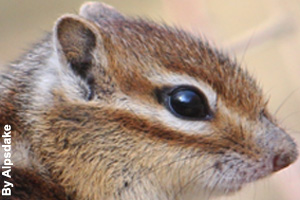
Close-up of a chipmunk's head
Chipmunk eating a seed
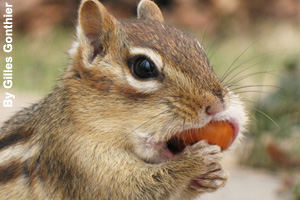
A chipmunk storing seeds in its cheek pouch
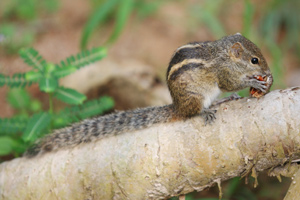
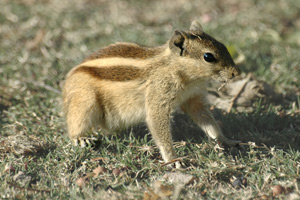
Notice the stripes on the chipmunk's back
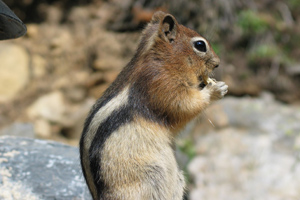
A sitting chipmunk using its paws to eat
Two chipmunks playing
Chipmunk
Topic(s):   Chaparral Animals, Forest Animals, Grassland Animals, Mammals, Woodland Animals
Quick Facts
Type of Animal
mammal
Biome(s)
deciduous forest (woodland); boreal forest (taiga); temperate
Habitat
forest, woodlands, grassland, chaparral, rock cliffs
Diet
mushrooms, nuts, snails, seeds, berries, acorns
Male
buck
Female
doe
Baby
pup
Group
scurry
Life Span
2 to 3 years (wild)
Migrates
no
Hibernates
yes
Predators
hawks, bobcats, weasels, snakes
Endangered
no

The chipmunk lives in California, Washington, the East and Midwest. It likes to make its home in forests and brushy areas. You can see it in open wooded country. A chipmunk is a tame animal. It is fun to watch. It has become very popular in our national parks.

A chipmunk is part of the same family as a squirrel. It has white stripes on its back. Its color is tan and brown. It also has a long brown tail. The tail turns up while it stands on its back legs. A chipmunk likes to eat in this position.

It eats acorns, fruits, and berries. A chipmunk stores its food in burrows. Burrows are underground tunnels.

A female chipmunk will make an underground nest. She will give birth to five or six babies. She might have a second litter of babies.

Citation information

APA Style: Chipmunk. (2020, April). Retrieved from Facts4Me at https://www.facts4me.com

MLA Style: "Chipmunk." Facts4Me. Apr. 2020. https://www.facts4me.com.

Back To Previous Back To Top
Copyright © 2006 - 2026, Facts4Me. All rights reserved.