


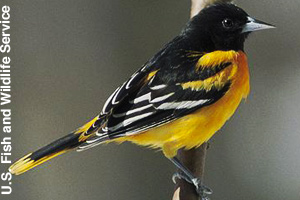
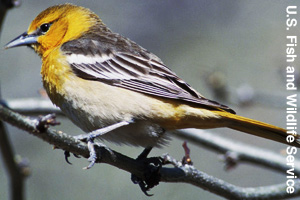
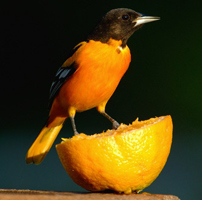
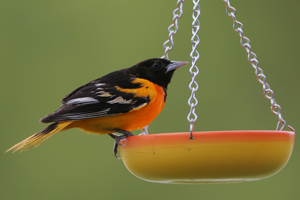

The male oriole has a bright orange body. Its head, back, wings and tail are black. The female is a duller color. It is olive and yellow with just a hint of orange. At seven to eight inches (about 18 centimeters) long, it is slightly smaller than a robin.
The Baltimore oriole was named after a different bird in Europe. People thought they looked alike. It is not really related to that bird. It is more closely related to the blackbird.
In summer, it lives in the eastern half of the United States and into Canada. In winter, it goes to Florida and southern Mexico. It may go as far south as Ecuador.
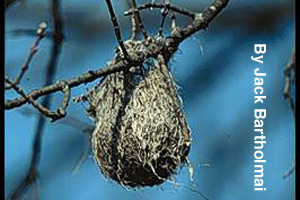
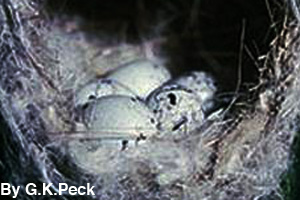
The female builds the nest in the spring. The nest looks like a pouch hanging near the tip of a branch. Plant fibers, bark, moss and fur might be used to make the nest. The mother lays up to four eggs. The eggs are light gray with dark streaks and spots. Each egg hatches after 11 to 14 days. A baby oriole is ready to leave the nest in about two weeks.
APA Style: Baltimore Oriole. (2013, June). Retrieved from Facts4Me at https://www.facts4me.com
MLA Style: "Baltimore Oriole." Facts4Me. Jun. 2013. https://www.facts4me.com.