

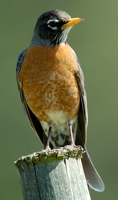
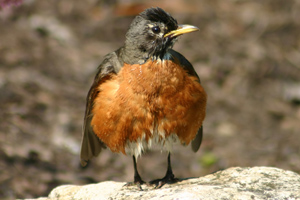

The American robin is the biggest thrush. It is 8 to 11 inches (20 to 30 centimeters) long. It has a black head, gray back and a reddish front. The robin lives in most of the United States and Canada. It does not live in Hawaii.
The robin likes to live close to lawns and gardens. It is easy for the robin to find worms there. The robin likes to eat worms and bugs in the summer. In the winter, it eats mostly berries.
The robin joins a flock, a large group of birds, in the winter. If it doesn’t get too cold and if there is plenty of food, the flock does not fly very far south.
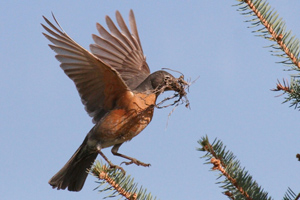
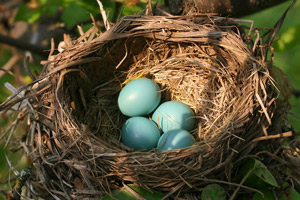
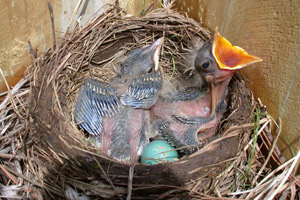
The robin makes a nest in the spring. The nest is shaped like a cup. It is made of twigs, grass and feathers on the outside. There is a layer of mud in the middle. The inside has feathers and grass to make it soft. The mother robin lays three to seven blue eggs.
The robin’s biggest enemy is pollution. Lead from gasoline gets in the soil. Pesticides get in the soil, too. These things poison the robin. It can also get West Nile virus from mosquitoes. However, there are still plenty of robins.
APA Style: Robin. (2013, June). Retrieved from Facts4Me at https://www.facts4me.com
MLA Style: "Robin." Facts4Me. Jun. 2013. https://www.facts4me.com.