

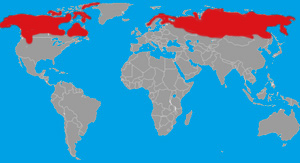
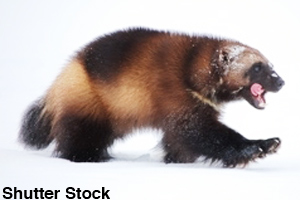
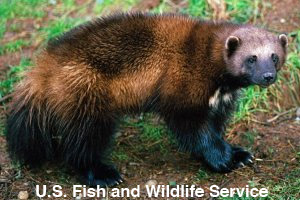
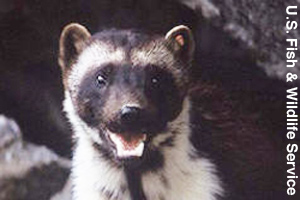

The wolverine likes to live where it is cold. It makes its home in arctic tundra, mountains, and pine forests. It can be found in Alaska, Canada, Northern Europe, Russia, and Siberia.
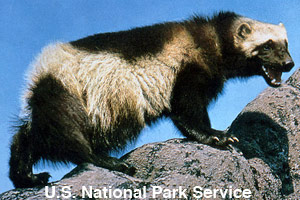
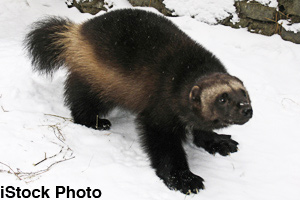
A wolverine is about the size of a big dog. Most of the wolverine’s body is dark brown. It has tan stripes. The stripes are on the head, neck, and sides of the body.
A wolverine has a strong body, big head, and long tail. Because a wolverine gives off a bad smell, it is sometimes called a skunk bear.
A wolverine is a very good hunter. It can run fast. It has sharp claws. This animal might follow its prey for days. It can kill large animals such as moose. Its tough jaw can break bones. It eats dead animals, too.
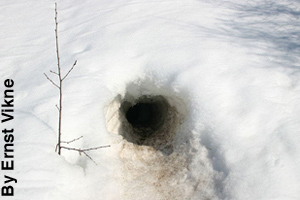
The wolverine lives alone. A female has two or three babies called kits in the spring. The female will dig a burrow in the snow to raise her kits. A kit stays with its mother for two years.
APA Style: Wolverine. (2020, May). Retrieved from Facts4Me at https://www.facts4me.com
MLA Style: "Wolverine." Facts4Me. May. 2020. https://www.facts4me.com.