

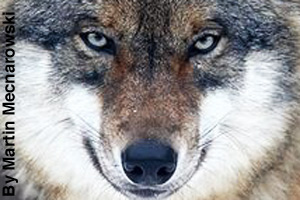
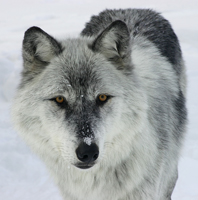
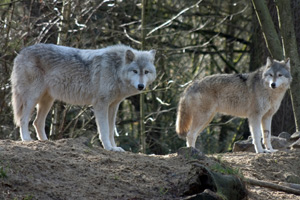
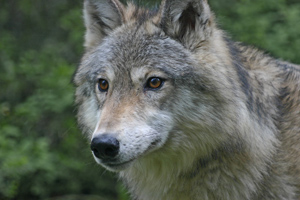



The gray wolf is the largest wild member of the dog family. It lives in forests and prairies. A gray wolf is also called a timber wolf or a tundra wolf.
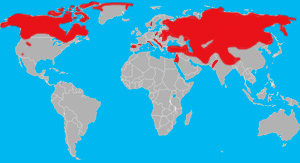
The wild wolf is found in the wilderness areas of Michigan, Wisconsin, and Minnesota. Some wolves are found in Alaska, Canada, and the arctic near the North Pole.
The gray wolf has very good sight and hearing. This wolf hunts mostly at night. It has powerful jaws. It can run very fast to catch its food. It eats mostly meat.
A gray wolf has thick fur. This protects it from cold weather. The color of its fur is black, gray, brown, and white. A gray wolf looks like a coyote but are bigger.
This wolf lives in a pack. A pack has six to ten wolves or more. The strongest male and female pair is called the alpha pair. The alpha female is in charge of the pups and the pack. Once a year, the alpha female has three to eight pups. The whole pack takes care of the pups. The alpha male is in charge of finding food for the pack. A pack of wolves hunt, eat, and play together.
The pack communicates with each other using sounds. The howls, growls, barks, and whines are how they talk to one another.
Gray wolf facts | Grey wolves | Timber wolf. (n.d.) Retrieved from https://animalfactguide.com/animal-facts/gray-wolf/
Gray wolf | Size, habitat, & facts. (n.d.). Retrieved from https://www.britannica.com/animal/gray-wolf
Gray wolf. (n.d.). Retrieved from https://naturemappingfoundation.org/natmap/facts/gray_wolf_k6.html
APA Style: Gray Wolf. (2020, August). Retrieved from Facts4Me at https://www.facts4me.com
MLA Style: "Gray Wolf." Facts4Me. Aug. 2020. https://www.facts4me.com.